How to Promote OnlyFans on Instagram with AI and Stay Inside the Rules
A practical workflow for promoting an OnlyFans page on Instagram with AI, plus what LinkedIn allows, how to read CPA and CTR, and where review slows you down.
ADS Beast editorial teamPublished 11 min read

You promote an OnlyFans page on Instagram by running a compliant Instagram presence and paid campaigns inside Meta's ad standards, using AI for planning, creative variants, policy pre-checks and report analysis. LinkedIn is not a distribution channel for adult offers. Use it to build a creator-business personal brand and move interested people to channels that allow the offer.
In short
- AI speeds up production and testing. It does not make adult content acceptable to a platform that restricts it.
- Instagram allows promotion only within Meta's ad standards; the account has to survive review on its own merits.
- LinkedIn restricts adult and sexually suggestive content, so direct OnlyFans offers usually fail review there.
- Treat LinkedIn as a personal brand and newsletter channel, not as a second Instagram.
- Budget, review time and results depend on your targeting, your creative and your account history, not on a fixed number.
What AI can and cannot do for an OnlyFans promotion
AI handles the work around publishing: drafts, variants, plans, banners, pre-checks and report reading. It does not change what Meta and LinkedIn permit, and it does not replace the account, the audience or the offer.
The useful split is simple. Everything that happens before you hit publish and after the campaign ends can be delegated to a model. Everything that depends on your face, your voice and your relationship with subscribers stays with you.
Before publishing, AI can:
- Draft captions and several variants of the same post so you are not writing from a blank page each day.
- Build a content plan across a week or a month and keep the themes from repeating.
- Generate banner concepts and layouts for testing.
- Check ad text against a platform's rules before you submit it, which saves a review cycle.
After publishing, AI can:
- Read campaign reports by CPA, CTR, CPC and CPM and tell you which ad is carrying the spend.
- Group results by creative type so you know what to make more of.
- Flag copy that reads as sexually suggestive before a human reviewer sees it.
What AI cannot do is get an adult offer approved where the platform does not allow it, or manufacture demand for a page nobody wants to subscribe to. If a tool promises to slip past ad review, that is a reason to walk away, not a feature.
Why Instagram is the harder platform to run, and what still works
Instagram is where the audience is, and it is also where the enforcement is strictest. Meta's ad standards restrict adult and sexually suggestive content, so your creative, your landing page and your account history all get read together.
Practical experience says the accounts that last are the ones that never make the platform's decision for it. A profile that looks like a person with a life, a niche and a reason to follow gets further than a profile that looks like a storefront.
Three things decide whether an Instagram promotion survives:
- The account itself. Age, posting history, follower quality and past violations all feed into how your ads and posts are treated.
- The creative. Suggestive framing, exposed skin and innuendo get flagged faster than a lifestyle shot with a clear caption.
- The destination. Where the link points matters as much as the ad. A page that itself breaks platform rules drags the ad down with it.
This is why "how to promote OnlyFans on Instagram" is rarely an ad problem first. It is an account and creative problem first, and an ads problem second.
Building the Instagram funnel step by step
The funnel has four stages: profile, content, link path and paid reach. Each stage has a job, and skipping one pushes the work onto the next.
Step 1: Make the profile carry the offer
Your bio, your pinned posts and your link have to answer one question fast: why should someone follow, and what do they get if they do? Keep the bio specific to your niche rather than generic. If your content is fitness, cosplay, gaming or music, say so. The niche is what makes the account defensible when a reviewer looks at it.
Step 2: Publish a content mix that does not read as one long ad
Alternate between three kinds of posts: personality (you, your day, your opinions), niche value (the thing you are actually good at) and soft promotion (a hint that more exists elsewhere). The soft promotion posts are the ones that convert, and they only work if the other two exist.
Step 3: Keep the link path clean
Where the link goes depends on what your audience uses and what the platform tolerates. A link-in-bio page, a newsletter or a messaging channel all work differently. Test one path at a time so you can tell which one is producing subscribers.
Step 4: Add paid reach only after the organic version works
Paid reach amplifies something that already converts. If organic posts get no engagement, an ad will buy you impressions and nothing else.
Using AI to write and test Instagram creative
AI is strongest at volume and variation. You want several versions of the same idea, then you want to know which one held up.
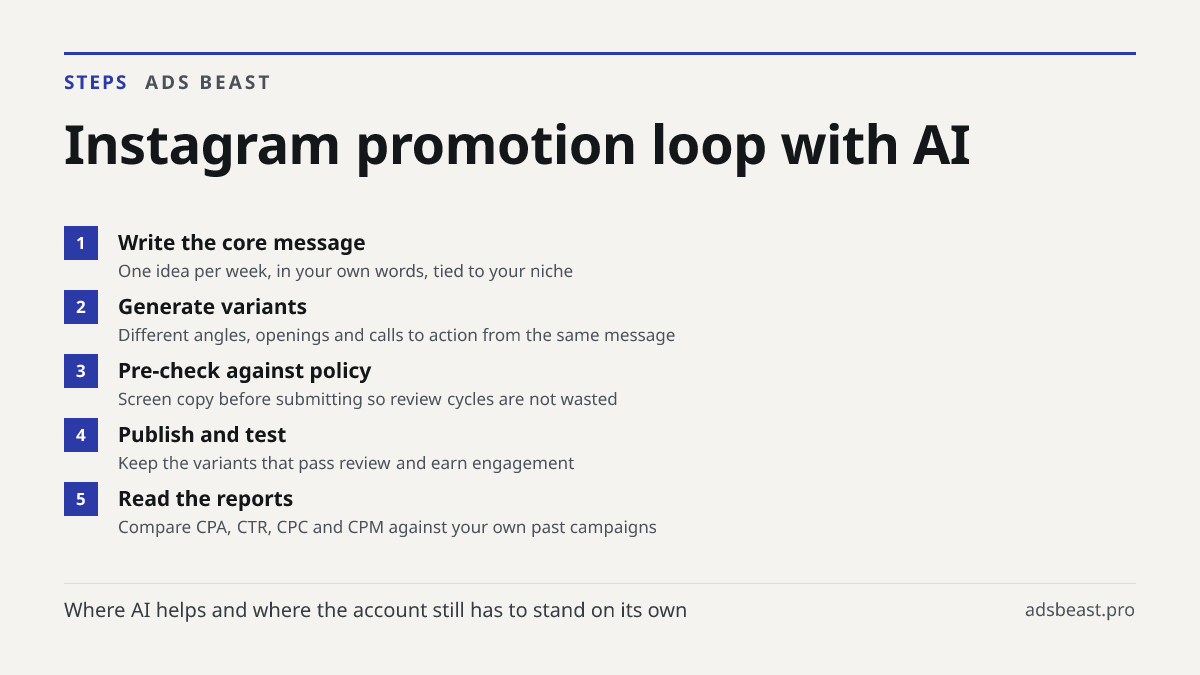
A workable loop:
- Write one core message for the week in your own words.
- Ask the model for several caption variants that keep the same message but change the angle, the opening line and the call to action.
- Run the policy pre-check on each variant before you submit anything.
- Publish or advertise the variants that pass, and keep the ones that get engagement.
- Feed the results back into the next week's plan.
The mistake most creators make is asking AI for "viral" captions. Ask for variants you can test instead. A caption that performs is a caption that matches your audience, and only your audience can tell you which one that is.
For the mechanics of running these campaigns inside Meta's systems, including how the platform's own automation interacts with your settings, see Meta Ads AI: Neural Networks in Facebook & Instagram Ads.
What LinkedIn actually allows, and how to use it
LinkedIn restricts adult and sexually suggestive content in its advertising policies, so a direct OnlyFans offer usually will not pass review. What can work is a personal brand, a newsletter or a creator-business angle, with interested people moved to a channel that allows the offer.
Think about who is on LinkedIn: people in work mode. The framing that fits is professional and text-led. If you are a creator who also runs a business, talks about the creator economy, or teaches something adjacent to your content, that is the angle.
What tends to work on LinkedIn:
- A profile that states plainly what you do, including that you are a creator.
- Posts about the business side: monetization, audience building, platform policy.
- A newsletter or a link to a resource that people can subscribe to.
- Ads that promote the personal brand or the newsletter, not the adult page.
What tends not to work:
- Suggestive imagery, which fails review and can damage the account.
- Direct offers, which the policies do not allow.
- Copy that tries to hint at the offer without naming it. Reviewers read intent, not just wording.
LinkedIn's rules and their enforcement change, so check the current advertising policies yourself before you build a campaign there. Do not build a plan on a blog post, including this one.
Comparing Instagram and LinkedIn for this job
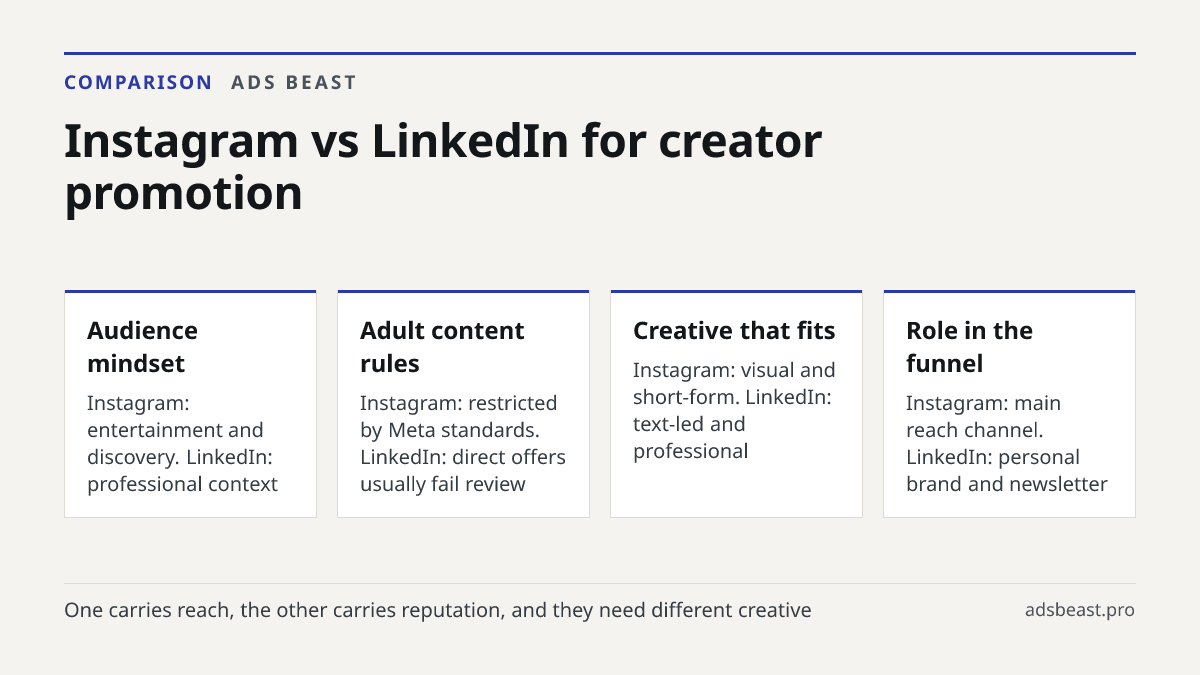
The two platforms are not interchangeable. They differ in audience, in what the policies allow and in what creative format performs.
| Audience mindset | Entertainment, discovery, personal | Professional, work context |
| Adult or suggestive content | Restricted by Meta's ad standards, enforced strictly | Restricted by LinkedIn's advertising policies, direct offers usually fail review |
| Creative that fits | Visual, short-form, lifestyle and niche | Text-led, professional framing |
| Realistic role in the funnel | Main channel for reach and audience building | Personal brand, newsletter, creator-business angle |
| Where interested people go next | Link path of your choice | Off-platform, to a channel that allows the offer |
| What to expect from review | Most ads reviewed within 24 hours, some longer | Policy-dependent, adult-adjacent creative gets more scrutiny |
The practical conclusion is that Instagram carries the promotion and LinkedIn carries the reputation. Running the same creative on both is the fastest way to lose both.
How to read the numbers AI gives you
AI reads reports faster than you do, but the numbers only mean something if you know what each one is. CPA is cost per acquisition, what you paid for one subscriber or lead. CTR is click-through rate, the share of people who saw the ad and clicked. CPC is cost per click. CPM is cost per thousand impressions.
Which of these matters depends on your goal:
- If you are buying reach, CPM tells you what attention costs.
- If you are buying traffic, CPC and CTR tell you whether the creative earns the click.
- If you are buying subscribers, CPA is the only number that decides whether the campaign continues.
None of these have a universal good value. They move with your country, your audience, your creative and the season. The way to find your own baseline is to run small tests, record the numbers, and compare each new campaign against your own history rather than against something you read online.
When you want the reporting and budget side handled inside one place instead of across spreadsheets, AI campaign setup and reporting tools cover the campaign build, budget pacing and the CPA, CTR, CPC and CPM reports in one flow.
Mistakes that get accounts restricted
Most restrictions come from patterns, not from one post. A new account that suddenly posts suggestive content, runs ads and changes its bio in the same week looks like what it is.
The patterns worth avoiding:
- Rushing a new account into paid promotion before it has any organic history.
- Using the same creative across platforms and hoping review will not notice.
- Writing copy that hints at the offer while pretending not to.
- Ignoring the first warning instead of slowing down after it.
- Treating a rejected ad as a technical problem to work around rather than a signal about the account.
If you are deciding who should run the campaigns, a specialist or a service, the trade-offs are covered in How to Order Targeted Advertising: Specialist or Agency. If you are comparing automation tools against a human team for the same job, Telegram Ads Agency or AI Platform: Which to Choose walks through the same decision for a different channel.
Where the budget actually goes, and why there is no fixed number
There is no single budget that works, because spend depends on your targeting, your bid and how many people you reach. Start small, watch what the campaign delivers, and scale only what already produces subscribers.
What shapes the number on Instagram:
- How narrow your audience is. Narrow targeting costs more per person reached.
- How competitive your country and category are.
- How much creative testing you are willing to fund. Testing costs money before it returns anything.
- How much of the funnel you run yourself versus paying someone else to run.
Meta does not publish a fixed minimum in its help center. The minimum depends on country, currency, objective and payment method, and Ads Manager warns you when a budget is too low. Google Ads also has no fixed minimum. LinkedIn is the one platform here that does publish numbers: a minimum daily budget of 10 USD and a minimum audience size of 300 people, with 50,000 recommended for better delivery.
A note on the learning phase, since it changes how you should read early results. Meta's learning phase runs for about 50 results in a week after the last significant edit, so every time you change the budget or the creative, you restart that clock. Editing daily is the fastest way to never get a stable read.
Next step
Pick one platform, one offer and one link path, then run a two-week test on Instagram with three to five creative variants and record CPA, CTR, CPC and CPM for each one. Do not touch LinkedIn ads until the Instagram version produces subscribers you can attribute. When you are ready to build the campaign and read the reports in one place, start with AI campaign setup.