
Meta Ads AI: How Neural Networks Run Facebook and Instagram Ads
How Meta Ads AI runs Facebook and Instagram campaigns: what the neural network decides, what stays with you, why learning phase stalls, and how to fix it.
ADS Beast editorial teamPublished 9 min read

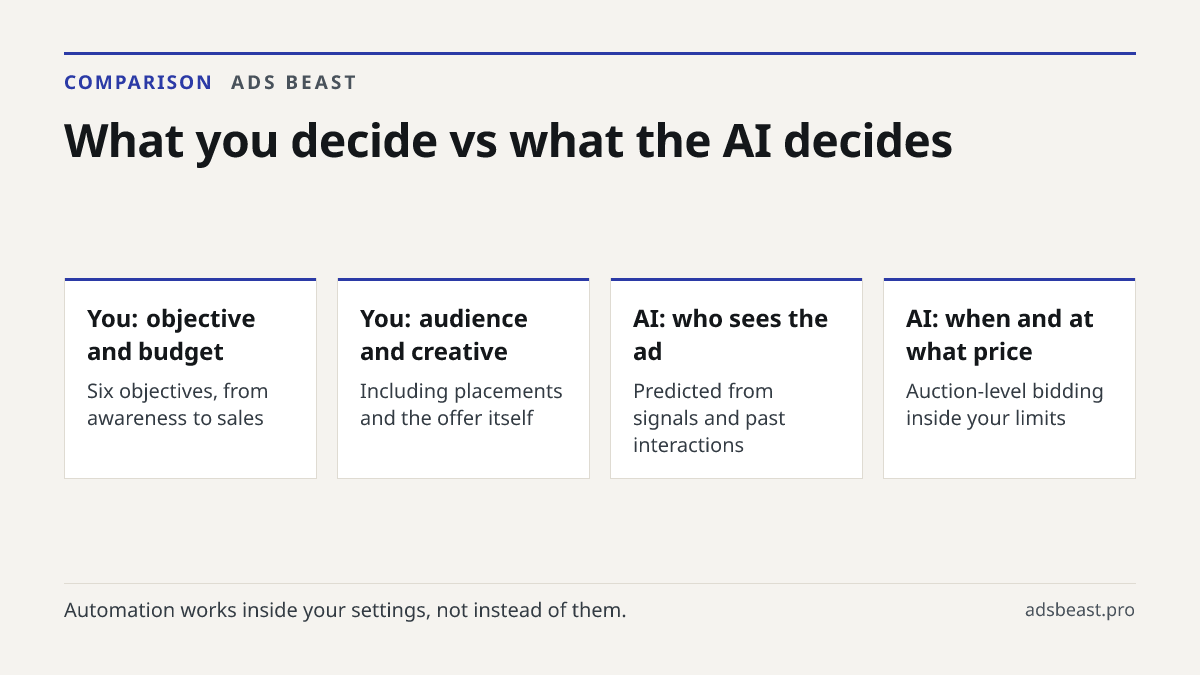
Meta Ads AI is the machine learning layer inside Meta's ad system that decides who sees each ad, when, and at what price. You set the objective, budget, audience, and creative. The system handles the auction decisions inside those settings, then learns from the results.
In short:
- Meta's delivery system is a prediction engine. It forecasts who is most likely to take the action you chose and bids accordingly.
- You still control the objective, budget, placements, audience, and creative. Automation works inside your settings, not instead of them.
- There are six campaign objectives: awareness, traffic, engagement, leads, app promotion, and sales.
- The learning phase ends after roughly 50 results in a week following your last significant edit. Frequent edits restart it.
- Most ads pass review within 24 hours. Some take longer.
What does Meta Ads AI actually automate?
It automates the auction-level decisions: which person sees your ad, in which placement, at what moment, and what the system is willing to pay for that impression. Everything above the auction stays with you.
That split matters because most disappointment with Meta advertising comes from expecting the machine to fix a setting that was wrong from the start. If your objective does not match the action you want, no amount of neural network optimization will produce it. The system optimizes toward the event you told it to optimize toward.
The prediction itself works on signals. Meta collects them from people who interact with your business: visits to your site, app activity, purchases, form submissions, messages. The richer and cleaner those signals are, the more accurately the system can find similar people. This is why the quality of your tracking setup affects delivery more than most creative decisions do.
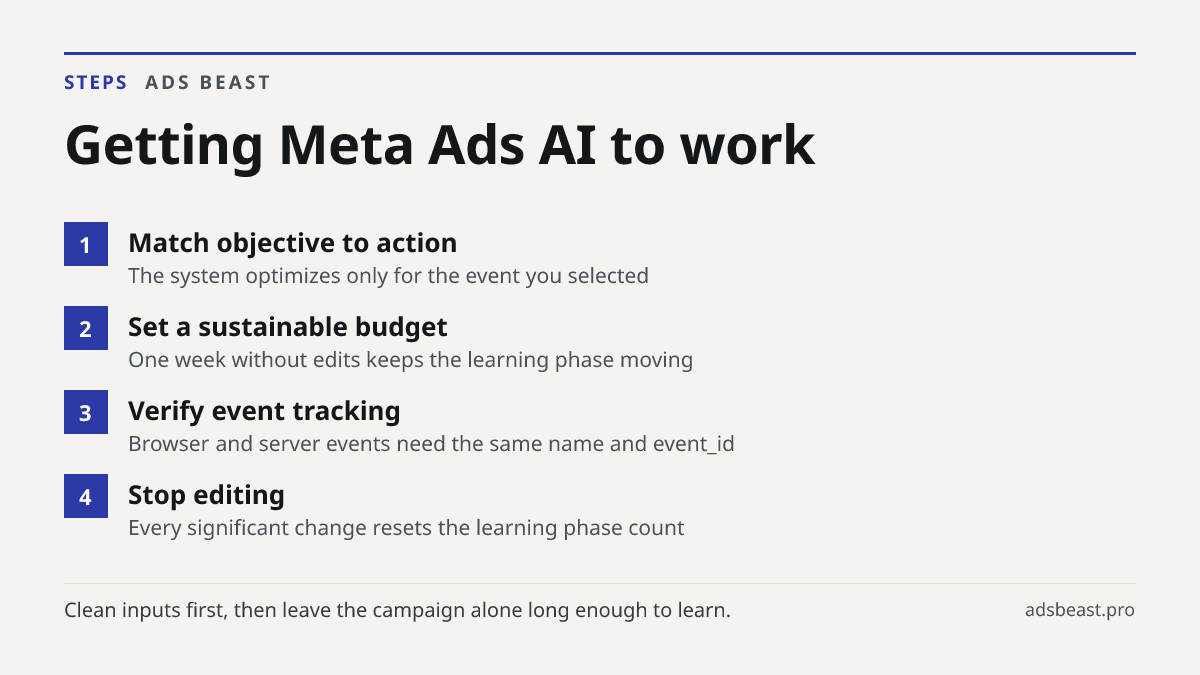
Meta's deduplication of browser and server events works by matching the event name and the event_id. There is no switch to turn on. If the two streams do not share those identifiers, the same conversion can arrive twice, and the system learns from inflated numbers.
Which six objectives does Meta offer, and which should you pick?
Meta offers six campaign objectives: awareness, traffic, engagement, leads, app promotion, and sales. Pick the one that names the action you actually want, because the objective determines which events the system optimizes for.
The older "conversions" and "messages" objectives no longer exist as separate choices. If your goal is messages, that now sits inside engagement or leads depending on what you are asking people to do. If your goal is a purchase, that is sales.
A common mistake is choosing traffic because it is cheaper per click, then complaining that nobody buys. Traffic optimization finds people who click. Sales optimization finds people who buy. Those are different audiences, and the second one usually costs more per click and less per sale.
| Objective | What the system optimizes for | Typical reason it fails |
|---|---|---|
| Awareness | Impressions and reach | Used when the real goal was leads or sales |
| Traffic | Link clicks and landing page views | Clicks arrive without purchase intent |
| Engagement | Interactions, messages, video views | Message quality varies, volume is not the goal |
| Leads | Form submissions or qualified contacts | Form is too long, or lead quality is not fed back |
| App promotion | Installs and in-app events | In-app events are not tracked properly |
| Sales | Purchases and other conversion events | Pixel and server events disagree, or the catalog is thin |
If you are still deciding whether to hand this work to someone else or keep it in-house, the tradeoffs are laid out in how to order targeted advertising: specialist or agency.
Why does the learning phase matter more than any single setting?
The learning phase is the period during which Meta's system gathers enough results to stabilize its predictions. It ends after roughly 50 results in a week following your last significant edit.
Every meaningful change to budget, creative, audience, or optimization resets that count. This is the single most common reason small campaigns never leave the learning phase: the advertiser keeps adjusting, and the system never gets a stable week to work with.
Practical consequences:
- Set a budget you can sustain for at least a week without touching it.
- Decide the creative before launch, not during the first three days.
- Change one variable at a time when you do edit, so you can tell what moved the result.
- If a campaign is stuck, check how recently it was edited before assuming the audience is wrong.
- Do not judge performance during the learning phase. The numbers there are noisy by design.
Campaigns with narrow audiences or small budgets take longer to accumulate results, simply because there are fewer people to show the ad to. That is arithmetic, not a platform flaw.
How does Meta's review process affect your launch timeline?
Most ads pass review within 24 hours, though some take longer. Edits to an existing ad can trigger a new review, and you can check the status in Ads Manager while the ad waits.
Review is not the same as performance approval. An ad can pass review and still deliver poorly because the system predicts low engagement. That distinction explains a lot of confusion: advertisers see "approved" and assume the ad is fine, then wonder why reach is flat.
What tends to slow review down or hurt delivery after approval:
- Landing pages that do not match what the ad promises.
- Claims that need substantiation you have not provided.
- Text-heavy images, which are allowed but often predicted to earn fewer interactions.
The old rule limiting text to 20% of an ad image is gone. Meta no longer rejects ads for text coverage alone. Heavy text can still reduce delivery because the system expects lower engagement, so keep the message readable on a phone screen and test a few versions rather than counting characters.
What does the AI not decide for you?
It does not decide your offer, your audience definition, your budget, or your creative. Those are the inputs. The neural network is the part that figures out how to spend inside them.
This is where most accounts improve fastest. Changing the offer or the first three seconds of a video moves results more than any bid adjustment. The system is good at finding people; it cannot make an unappealing offer appealing.
Audience setup deserves a note too. Broad targeting with strong signal quality often outperforms narrow interest stacks, because the prediction engine has more room to work. Narrow audiences are not wrong, they just give the system fewer options and take longer to learn.
If you want a second opinion on where the inputs are weak, a scheduled review of your own ad accounts, with CPA, CTR, CPC, and CPM in one place, is a reasonable starting point: AI campaign setup and account review.
How do you structure an account so the automation has room to work?
Give the system clean inputs and stop interfering with it. That is the whole method.
Consolidate similar campaigns instead of splitting the same audience across many ad sets. Fewer ad sets with more budget each reach the learning phase faster and give the prediction engine more data per decision. Fragmentation is the quiet killer of small accounts.
Then feed results back into the system. Server-side conversions built from your CRM stages tell Meta what happened after the click, not just that a click occurred. Without that feedback, the system optimizes toward the wrong people: those who click easily rather than those who buy.
Check your tracking before you blame the algorithm. Look at whether browser and server events carry the same event name and event_id. Look at whether the conversion you marked as primary is the one you actually care about. A surprising share of "the algorithm stopped working" cases turn out to be a tracking change nobody announced.
For the upstream decisions, how you frame the offer and the audience before any of this, how to advertise my business: guide and examples covers the groundwork.
Where does Meta Ads AI fit next to other channels?
Meta's strength is demand capture and demand creation among people who already use Facebook and Instagram daily. It is not the only channel, and it is rarely the only one worth running.
| Channel | What the AI layer optimizes | Where it fits |
|---|---|---|
| Meta (Facebook, Instagram) | Auction-level delivery across both apps | Broad consumer reach, visual products, local businesses |
| Google Ads | Search intent and Performance Max placements | People actively searching for what you sell |
| Telegram Ads | Placement inside channels, text limited to 160 characters | Audiences that live in messaging apps |
| Professional targeting with a minimum daily budget of 10 USD and a minimum audience of 300 people | B2B and role-based targeting |
Instagram can be run in ways that do not require a linked Facebook presence, which matters for creators and smaller businesses. The options are described in how to run ads on Instagram without Facebook: options. If your audience is elsewhere, how to advertise on Telegram: business guide covers that channel's constraints.
Local service businesses have a specific pattern worth knowing. Clinics, for example, depend on geography and trust signals more than on broad reach, which changes how you set radius, creative, and the action you optimize for. That is covered in dental social media advertising for local clinics.
What should you do first?
Pick one campaign that has been running for at least a week, and stop editing it. Then verify three things in order: that your objective matches the action you want, that your browser and server events share the same event name and event_id, and that your budget can sustain a week without changes.
Once those three are true, you have given the system what it needs to learn. Everything after that is testing creative and offer, which is the part no algorithm can do for you. If you want the campaign structure and tracking checked before you spend further, start with AI campaign setup.