
Instagram Advertising Price: What Your Campaign Will Cost
How Instagram ad pricing works: daily vs lifetime budgets, what drives your cost per result, and how to set a budget you can actually judge.
ADS Beast editorial teamPublished 9 min read
The Instagram advertising price is not a rate card. You pay for delivery in an auction, so your cost per result depends on your objective, audience, placement, creative quality, and how many advertisers bid for the same people at the same time. Budget is the lever you control.
In short
- Instagram ads are bought through an auction, so there is no fixed price per ad, per click, or per thousand views.
- You set either a daily budget (an average per day) or a lifetime budget (a cap across the whole schedule).
- Meta can spend up to 25% more than your daily budget on a given day, as long as the weekly total stays within seven times that daily figure.
- Your real cost per result is reported in Ads Manager. Compare it to your own target, not to a number someone posted online.
- Very small budgets slow delivery and produce too little data to judge whether the ad works.
What actually determines the Instagram advertising price
Your cost is set at auction time, not by a published price list. Every time someone is eligible to see your ad, Meta runs a small auction among the advertisers targeting that person. The winner is not simply the highest bidder. Meta weighs your bid against the estimated action rate (how likely that person is to take the action you want) and the quality of your ad. A well-made ad that people engage with can win placement against a higher bid.
That is why two businesses in the same niche can pay very different amounts for the same audience. The auction also explains why the average cost for social media advertising moves around so much between industries, countries, and months. There is no stable national number to look up, because the price is rebuilt with every impression.
What you can control:
- Objective. Awareness, traffic, engagement, leads, and sales each optimize for a different action, and the cost per result differs accordingly.
- Audience size and competition. A narrow audience in a crowded category costs more than a broad one in a quiet category.
- Placement. Feed, Stories, Reels, and Explore have different supply and different behavior.
- Creative. Strong creative raises estimated action rates and lowers what you pay per result.
- Season. Costs rise when many advertisers compete for the same people, such as during major shopping periods.
For a deeper look at how the auction and delivery system work behind the interface, see How Does Instagram Advertising Work: Meta Ads Mechanics.
Daily vs lifetime budget: which one to choose
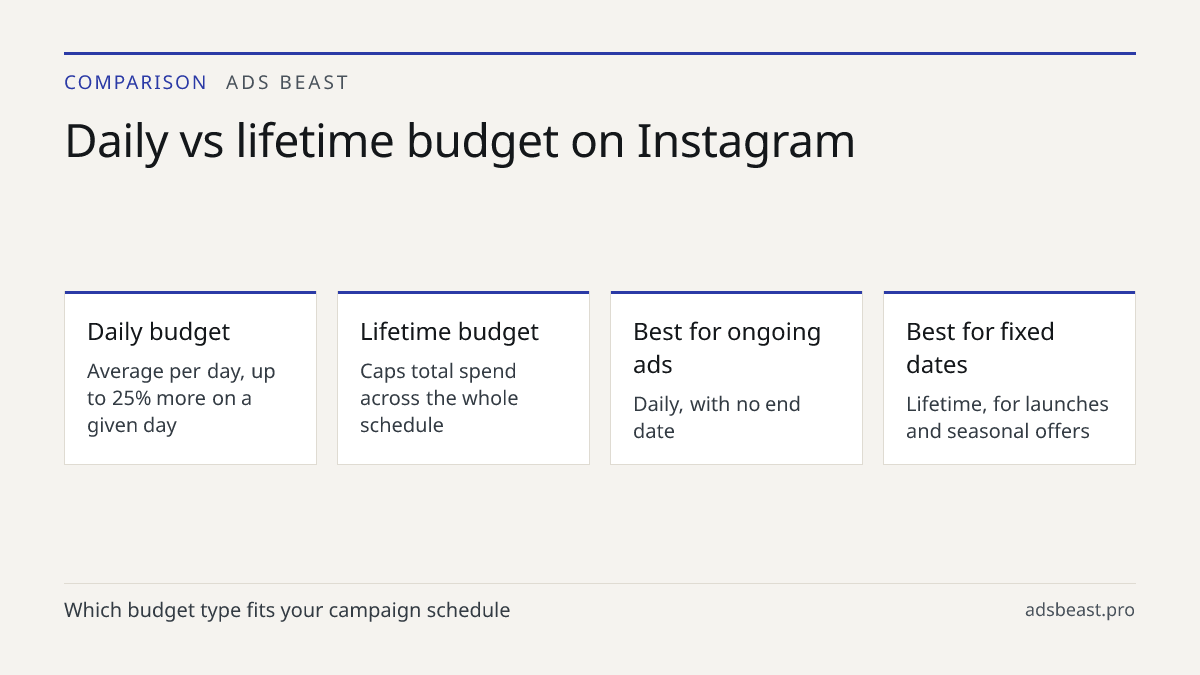
A daily budget is the average amount you are willing to spend per day. Meta can spend up to 25% more than that on any single day, as long as the total across the week stays within seven times your daily budget. A lifetime budget caps total spend across the entire schedule and lets the system shift money toward the days and times that produce better results.
| Daily budget | Lifetime budget | |
|---|---|---|
| What it controls | Average spend per day | Total spend across the schedule |
| Flexibility | Up to 25% more on a given day, weekly total capped | System moves spend toward stronger days |
| Best for | Ongoing campaigns with no end date | Ads with a fixed start and end date |
| Unspent money | Carries into the next day within the weekly cap | Not charged if the schedule ends with budget left |
Pick daily when the campaign runs continuously and you want steady pressure. Pick lifetime when you are promoting a specific event, launch, or seasonal offer and need the spend to land inside a defined window.
Where you set and change the budget
In Ads Manager you choose the budget at campaign level or at ad set level. Campaign-level budgeting (often called Campaign Budget Optimization) lets Meta distribute spend across your ad sets automatically, based on which ones perform better. Ad set budgets give you manual control, so you decide exactly how much each audience gets.
You can edit either while the campaign runs. The catch is that significant changes reset the learning phase, and during learning the system is still gathering data to optimize. If you keep adjusting budgets every day, the campaign never settles and your results stay noisy. Decide your number, give it enough time to produce data, then adjust.
If you would rather not manage this yourself, it helps to know when a specialist Google Ads: when you need an expert vs AI is worth the fee, since the same logic of when to hand over campaign management applies to paid social.
How to set a starting budget you can judge
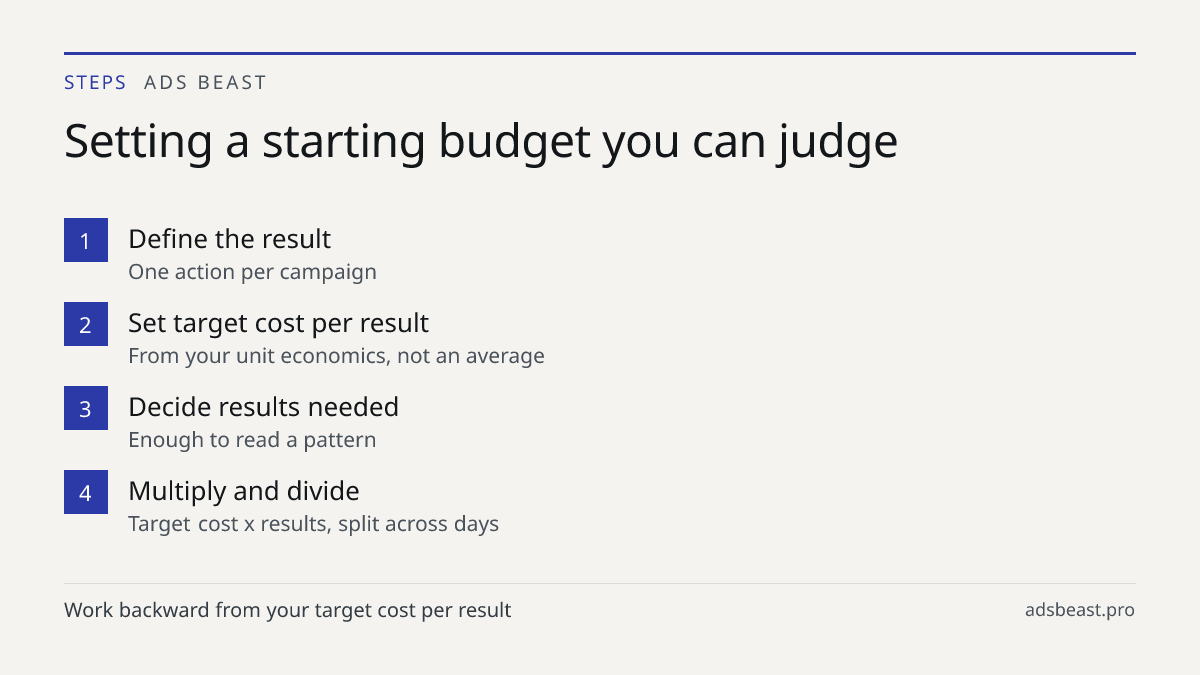
There is no minimum you must spend to run Instagram ads, but your budget has to be high enough to generate enough impressions and results for the system to optimize. The practical method is to work backward from your target cost per result.
- Define the result you are buying. A lead, a purchase, a profile visit, a message. One action per campaign.
- Set a target cost per result you can live with. This comes from your unit economics, not from an industry average.
- Decide how many results you need to judge the ad. A handful is not enough to read a pattern.
- Multiply target cost per result by the number of results you need. That is your minimum viable budget for the test.
- Divide by the number of days you want the test to run to get your daily figure.
If step four produces a number you cannot afford, the honest answer is that the test will not tell you much. A budget too small to produce results is not a cheap test, it is an unreadable one.
Why your cost per result came in higher than expected
Cost per result depends on your objective, audience size, placement, ad quality, and how many other advertisers bid for the same people at the same time. Narrow audiences and competitive periods push costs up. Broader targeting and strong creative tend to bring them down.
Common causes of a surprise:
- Audience too small. You are competing for a limited pool, so the auction clears higher.
- Too many placements at once. Automatic placements can send spend to cheap, low-intent inventory.
- Weak creative. Low engagement lowers your estimated action rate, so you pay more to win the same placement.
- Objective mismatch. Optimizing for a shallow action when you need a deeper one makes the cost look low but the value look wrong.
- Learning phase churn. Frequent edits keep the campaign from optimizing.
Meta reports your actual cost per result in Ads Manager. Read it there, and compare it to your own target rather than a fixed benchmark from someone else's account.
How budget pacing works day to day
When you set a daily budget, Meta's delivery system spreads that amount across the day and aims to spend it fully while your ad is active. If you pick a lifetime budget, the system paces spending across the whole schedule instead, and unspent money is not charged. You can check actual spend and pacing any time in Ads Manager.
Pacing exists so your budget is not burned in the first hour and then dark for the rest of the day. It also means a campaign can underspend if your audience is small, your bid is too low, or your creative stops being shown. Underspend is a signal worth reading: it usually means the auction is rejecting your bid or your audience is exhausted.
Where Instagram sits inside a wider paid social budget
Instagram is one placement inside Meta's system, and most advertisers run it alongside Facebook, and often alongside other channels. When you plan a paid social media advertising cost, treat Instagram as one line in a portfolio rather than a standalone number. The same creative, the same pixel, and the same reporting cover Facebook, so the marginal cost of adding Instagram is mostly budget, not setup.
If you are comparing channels, the question is rarely which one is cheapest in isolation. It is which combination produces the most cost effective social media advertising for your specific offer. A low cost per click on a channel that sends you unqualified traffic is not cheap. A higher cost per result on a channel that converts is. For a comparison of search-side costs, see How much do Google Ads cost? Management pricing guide, and for a channel with a different pricing model entirely, Telegram advertising: launch campaigns and buy placements.
Low cost social media advertising usually comes from tight creative and a clear offer, not from finding a hidden cheap placement. The auction does not have a discount aisle.
Agency and management costs sit on top of ad spend
Your Instagram advertising price has two parts: the money that goes to Meta as ad spend, and the money you pay someone to run the account. Ad spend goes to the platform. Management is a separate line, and it is priced in different ways depending on who you work with.
What shapes the management fee:
- Scope. One campaign is not the same as a full funnel with creative, landing pages, and reporting.
- Who does it. A freelancer, an agency, or your own team, each with different overhead.
- Retainer vs project. Ongoing management is usually a recurring fee, project work is usually fixed.
- Ad spend level. Some managers price as a share of spend, some as a flat fee regardless of spend.
The right question is not "what does management cost" but "what does management cost relative to the results it produces." A manager who lowers your cost per result by more than their fee is worth it. A manager who only reports spend is not. If you are deciding whether to bring someone in, Hire a PPC specialist: when paid ads help pays off walks through the trade-offs.
Next step
Before you launch, write down three numbers: your target cost per result, the number of results you need to judge the ad, and the daily budget that follows from them. Then set the campaign to that budget and leave it alone long enough to produce data. If you want the setup handled for you, start here: instagram advertising price.