Instagram Ads: Launch, Target, Measure Performance
How to launch Instagram ads, build targeting that survives the learning phase, and measure cost per result in Ads Manager without guessing.
ADS Beast editorial teamPublished 11 min read
Instagram ads run inside Meta Ads Manager, where you choose an objective, a budget, an audience, and a placement. Setup takes under an hour. The work that decides your cost per result is the offer, the creative, and how you read the data afterward.
Short version
- Objective first, creative second, audience third. Changing that order wastes budget.
- Meta charges per impression or per click. There is no flat fee and no minimum contract.
- Audience size between 50,000 and 500,000 people gives the algorithm room to optimize.
- The learning phase lasts roughly 50 optimization events, usually 3 to 7 days.
- CTR below 1 percent points to creative or targeting. Healthy CTR with weak sales points to the landing page.
What are Instagram ads and where do you run them?
Instagram ads are paid posts delivered through Meta Ads Manager, the same tool that runs Facebook campaigns. You can also start them from the Instagram app by boosting posts, but the app hides most controls. Ads Manager is where you set objectives, audiences, placements, and budgets.
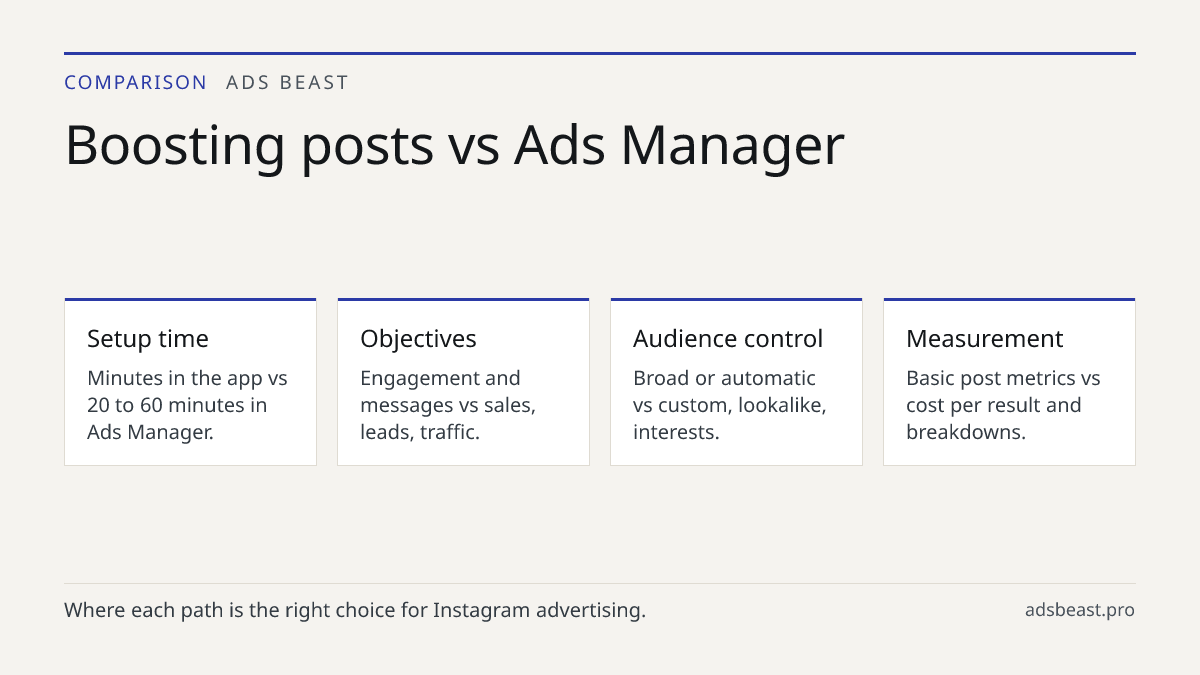
The two paths differ more than they look.
| Boosting posts on Instagram | Ads Manager campaign | |
|---|---|---|
| Setup time | A few minutes in the app | 20 to 60 minutes |
| Objectives | Engagement, profile visits, messages | Sales, leads, traffic, awareness, app installs |
| Audience control | Broad or automatic | Custom, lookalike, detailed interest targeting |
| Placements | Feed and Reels by default | Feed, Stories, Reels, Explore, manual selection |
| Measurement | Basic post metrics | Cost per result, breakdowns, attribution windows |
| Pixel and Conversions API | Not available | Full support |
Boosting works when you want reach on a post that already performs. For anything with a conversion goal, build the campaign in Ads Manager. Instagram advertising shares its auction with Facebook, so your budget competes against every other advertiser on Meta, not just other Instagram advertisers.
How do you launch an Instagram ad campaign step by step?
Launching means building one campaign, one ad set, and one ad, then leaving them alone long enough to collect data. The most common early mistake is editing the ad set every day and resetting the learning phase before it finishes.
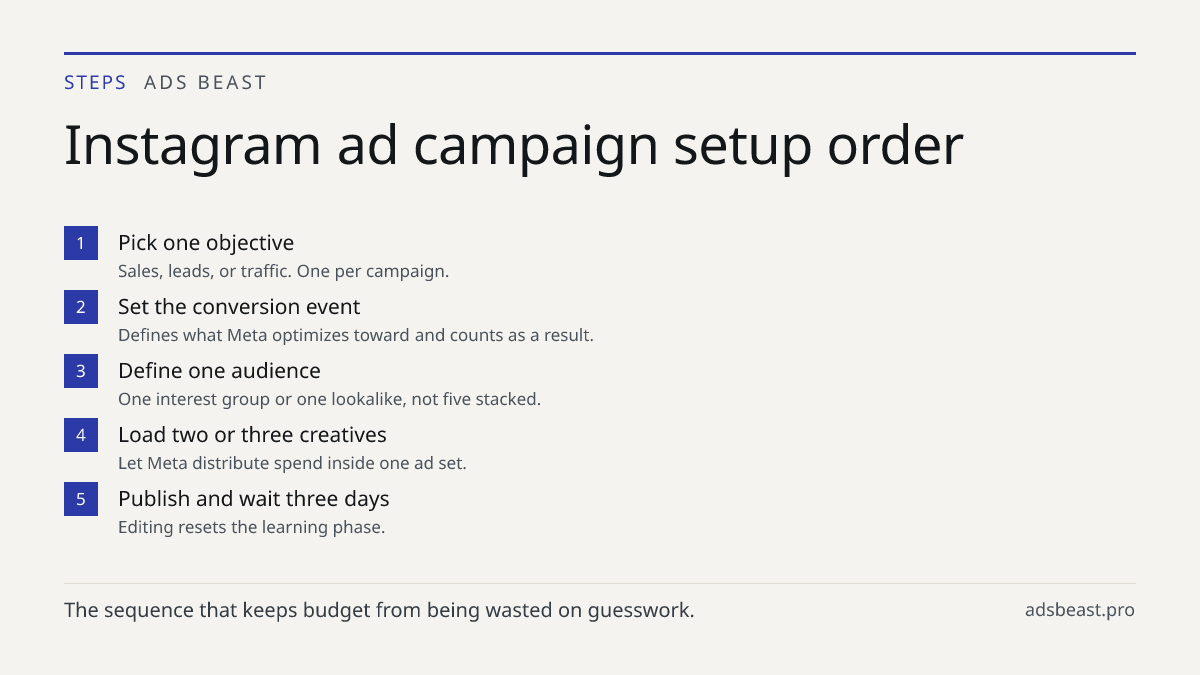
- Pick a single objective. Sales if you have the Meta Pixel installed, leads if you collect signups, traffic if your site converts well on its own. One objective per campaign.
- Set the conversion event. Purchase, lead, or add to cart. This is the event Meta optimizes toward, and it defines what counts as a result.
- Define the audience at the ad set level. Start with one interest group or one lookalike, not five stacked together.
- Choose placements. Automatic placements usually win on cost. Manual placement makes sense when you know Reels outperforms Feed for your product.
- Set the budget at the ad set level. Daily budgets are easier to control than lifetime budgets when you are still testing.
- Load two or three creatives into one ad set. Let Meta distribute spend across them instead of running separate ad sets per creative.
- Publish and do not touch it for at least three days.
If you already advertise elsewhere, the account and tracking setup carries over. The same discipline applies to ad operations for agencies, where campaign structure and naming decide how readable your reporting is later.
Campaign objectives that matter for Instagram
Sales and leads are the only objectives that optimize toward revenue. Traffic, engagement, and awareness objectives cost less per click but rarely produce purchases, because Meta finds people who click rather than people who buy. Use them for list building or content distribution, not for direct sales.
Naming conventions you will thank yourself for later
Name campaigns as objective_audience_creative_date. Six months in, you will have dozens of campaigns and no memory of which one was the Reels test. The name is the only thing that survives.
How do you target the right audience on Instagram?
Targeting works when the audience is broad enough for the algorithm to find buyers and specific enough to exclude people who will never convert. Meta requires at least 1,000 people in an audience before an ad set can run, but that floor is a technical limit, not a strategy.
Three targeting types cover most campaigns:
- Detailed interest targeting. You pick interests, behaviors, and demographics. Good for a new account with no conversion history.
- Custom audiences. Your customer list, site visitors, video viewers, or people who engaged with your profile. Good for retargeting.
- Lookalike audiences. Meta builds a similar audience from a source list. Needs a source of at least a few hundred people to be useful.
Broad targeting with no interests at all works once you have pixel data, because the algorithm optimizes from real conversion signals rather than your guesses. Before that, interests give it a starting point.
Audience size and why narrow targeting costs more
Aim for 50,000 to 500,000 people. Below that, delivery becomes inconsistent: the same audience sees your ad too often, frequency climbs, and CPM rises because you are bidding against yourself for a small pool. Above a few million, the audience is broad enough that creative does the targeting work.
Retargeting sequence that does not annoy people
Show a different message at each stage. Someone who watched 25 percent of a video is not the same as someone who abandoned checkout.
- Engaged but never visited the site: introduce the product.
- Visited a product page, no add to cart: show the product with a reason to return.
- Added to cart, did not buy: address the objection, shipping, returns, or price.
- Purchased: exclude them. Nothing burns budget faster than advertising to people who already bought.
What creative actually performs in Instagram ads?
Creative decides most outcomes. Meta's delivery system finds the audience, but the first frame, the hook, and the offer decide whether anyone stops. Feed and Reels behave differently enough that one asset rarely wins in both.
For sponsored posts in Feed, the first line of text carries the hook, since users see the caption before they commit to the image. For Reels and Stories, the first second of video does that job. Vertical video, native-looking footage, and text that reads without sound cover most placements.
If you plan to run the same product on other platforms, creative preparation differs more than people expect, as covered in TikTok ads creative preparation. Instagram rewards a polished, static-friendly look; TikTok rewards roughness. Reusing one asset across both usually underperforms on one of them.
Before writing anything, look at what competitors already run. The Facebook Ads Library for competitor research shows live ads, how long each has been running, and which angles they keep. An ad running for months is usually profitable. That is free research.
How much do Instagram ads cost?
You set the budget. Meta charges per impression or per click through an auction, so there is no fixed price and no minimum contract. Most small businesses start at $10 to $20 per day, which is enough to gather data in the first week without burning money on an unproven offer.
Minimum daily budgets sit around $1 for impression-based goals and $5 for click-based goals. Spending that little rarely produces useful results, because the algorithm needs volume to optimize.
Your actual cost per result depends on:
- Audience competition. More advertisers bidding on the same people raises CPM.
- Placement. Reels and Stories usually cost less per impression than Feed.
- Season. Costs climb during peak shopping periods.
- Creative quality. Meta rewards ads people engage with, so weak creative pays more per result.
- Conversion event. Purchase events cost more per result than add-to-cart events, because they are rarer.
There is no universal benchmark worth trusting. Compare your cost per result against your own margin, not against a number from a blog post.
How do you measure Instagram ad performance?
Measurement happens in Meta Ads Manager, with Instagram Insights as a secondary source for organic context. Ads Manager reports impressions, reach, CTR, CPC, CPM, and cost per result, broken down by ad, audience, placement, and time.
Connect the Meta Pixel or the Conversions API before you spend. Without it, Meta sees clicks but not sales, and the algorithm optimizes toward the wrong people. If you also run search, keep the reporting consistent across platforms so you compare like with like, the way agencies do in a unified advertising dashboard.
Metrics that tell you what to fix
| Metric | What it tells you | What to do when it is off |
|---|---|---|
| CTR | Whether the creative and targeting connect | Below 1 percent: rewrite the hook or narrow the audience |
| CPC | Cost of getting the click | Rising CPC with stable CTR means auction pressure, not creative |
| CPM | Cost of reaching 1,000 people | High CPM on a small audience means you are bidding against yourself |
| Cost per result | What each conversion costs | Compare against margin, not against a benchmark |
| Frequency | How often one person saw the ad | Above 3 to 4 in a short window, refresh creative |
| Conversion rate | Whether the landing page closes | Low with healthy CTR points to the page, not the ad |
Read CTR first. It separates a creative problem from a landing page problem faster than any other metric.
Attribution windows and why your numbers differ from analytics
Meta counts a conversion within a set window after a click or view, defaulting to 7-day click and 1-day view. Your analytics tool counts sessions and may attribute the same sale to a different source. Both are correct within their own definitions. Pick one source of truth for decisions and stop reconciling the two every morning.
What to do when Instagram ads are not converting?
Diagnose in order: creative, then audience, then landing page. Checking them out of order leads to rewriting ad copy when the real problem is checkout.
- CTR below 1 percent. The creative or the targeting is wrong. Test a new hook before changing anything else.
- Healthy CTR, low conversions. The landing page or checkout is losing people. Match the page headline to the ad promise.
- Broad audience, weak results. Narrow to one interest group or a lookalike and let it run.
- Strong start, fading performance. Frequency climbed. Refresh creative or expand the audience.
- Conversions reported in Meta but not in your store. The pixel may be firing on the wrong event or double-counting. Check the event setup.
One more cause people miss: the offer itself. A discount that does not beat the competition, or a product page with no reviews, will not convert regardless of how well the ad performs.
Next step
Open Ads Manager, duplicate your best-performing ad set, and change exactly one variable: the creative, the audience, or the landing page. Run it for at least three days before judging. If you want the campaign structure and tracking handled end to end, start with Meta ads management.
FAQ
How much does it cost to run Instagram ads?
You set your own budget, and Meta charges per impression or per click rather than a flat fee. Most small businesses start with $10 to $20 per day, enough to gather data in the first week. Minimum daily budgets are around $1 for impressions and $5 for clicks, but spending that little rarely produces useful results.
What is the minimum audience size for Instagram ads targeting?
Meta requires an audience of at least 1,000 people before your ad set can run. In practice, aim for 50,000 to 500,000 people so the algorithm has room to optimize. If your targeting is too narrow, costs rise and delivery becomes inconsistent.
How long does it take for Instagram ads to start working?
The learning phase usually lasts about 50 optimization events, which can take 3 to 7 days at a moderate budget. Performance often dips during this period, so avoid editing the ad set. Once it exits learning, cost per result typically drops by 20 to 40 percent.
Where do I measure Instagram ad performance?
Meta Ads Manager shows impressions, reach, CTR, CPC, CPM, and cost per result, broken down by ad, audience, and placement. Use Ads Manager for campaign data and Instagram Insights for organic context. For conversions, connect the Meta Pixel or Conversions API so sales and signups are tracked beyond the platform.
Why are my Instagram ads not converting?
The most common causes are a weak offer, a mismatch between the ad creative and the landing page, or an audience that is too broad. Check your CTR first: below 1 percent usually means the creative or targeting needs work. If CTR is healthy but conversions are low, the problem is almost always the landing page or checkout flow.
Should I boost posts or build campaigns in Ads Manager?
Boost posts when you want cheap reach on content that already performs and have no conversion goal. Build campaigns in Ads Manager for anything measured by sales, leads, or cost per result. Boosting gives you almost no audience control and no pixel tracking.